So many books on coaching! What to read?
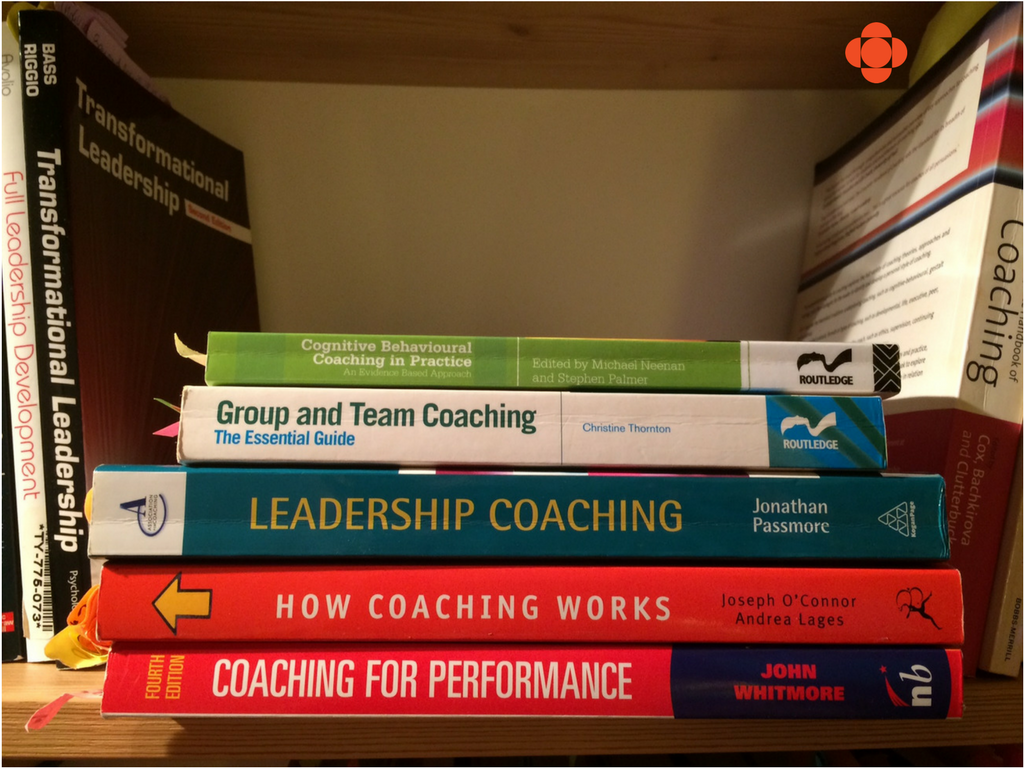
There are so many books about coaching and it’s quite hard to navigate through all the titles to find what really matches your needs. I can’t claim to have read everything there is to read about coaching, but here are a few tips from my bookshelf.
If you are new to coaching, or just curious to know what all the buzz is about, I would suggest these two introductory books.
Coaching for Performance, Growing human potential and purpose , by Sir John Whitmore, one of the pioneers of coaching in the UK, was first published in 1990 at a time when there were not many books on coaching, and research in the field was still scarce. It is written from a practitioner’s perspective and has the merit of having introduced coaching as a management style that could be used to transform workplaces into values-driven and more humane enterprises. Sir John explained the nature and process of coaching, and popularized the now famous GROW model which was initially developed by Graham Alexander a decade before.
How coaching works , by Joseph O’Connor and Andrea Lages is a very good overview of coaching, where it comes from and how it developed into a vastly popular profession. The authors present the history of coaching, portraying the key players in the US and in Europe who were at the rise of this new profession starting from the 1970s, and they note the social and environmental factors that enabled the emergence of coaching in the 20th century. They describe the various multidisciplinary influences on coaching and describe some of the most well known approaches, such as integral coaching, ontological coaching and NLP, as well as presenting their own integrated model. A very good read that familiarizes you with the profession.
If you are a coaching professional, and are looking for specialist texts, I would recommend these research-based books that provide sound knowledge and practical models of coaching that you can use immediately.
Leadership Coaching, Working with leaders to develop elite performance, edited by Jonathan Passmore is a must-have on your bookshelf if you work with executives and senior officials. This collection of contributions by eminent scholars and practitioners covers all the key topics of leadership coaching, such as authenticity, emotional intelligence, derailing leadership and transformational leadership. The book presents research-based techniques and models that will help you to develop leaders in many different contexts, from strategy coaching to working with political leaders or global teams.
Group and Team Coaching: The Essential Guide , by Christine Thornton is really a treasure trove of information, knowledge and practical guidelines on how to coach groups and teams. The author unbundles the processes of group dynamics and how these play out in a coaching situation. She also explores the life of groups from a systems perspective giving plenty of tips on how to work within complex organizational environments. Lastly, she gives guidance on how to tackle problem behavior in group settings. I found it to be an excellent, highly practical read, based on solid research.
Cognitive Behavioural Coaching in Practice , edited by Michael Neenan and Stephen Palmer presents a theoretical model that aims at understanding and changing inner blockages, together with lots of tools to address various coaching topics, for example building resilience, managing stress, reinforcing self-esteem and enhancing performance. The authors present many vignettes and sample coaching dialogues to illustrate their models. Each chapter ends with a long list of references if you want to read further on the subject.
Tales for Coaching, Using Stories and Metaphors with Individuals and Small Groups , by Margaret Parkin. The first part of the book presents the history, purpose and benefits of story-telling and how these can have a transformative effect on how coaching clients develop a new narrative about their situation. The second part is a collection of poems and stories that you can readily use or adapt in your practice. It is an excellent resource for both corporate and life coaches.
Happy reading!
I would love to hear back from you if read these books, or if you have any other books on coaching that you’d like to recommend.
Please put your comments in the text box below!