
A Listeners’ Convention?!
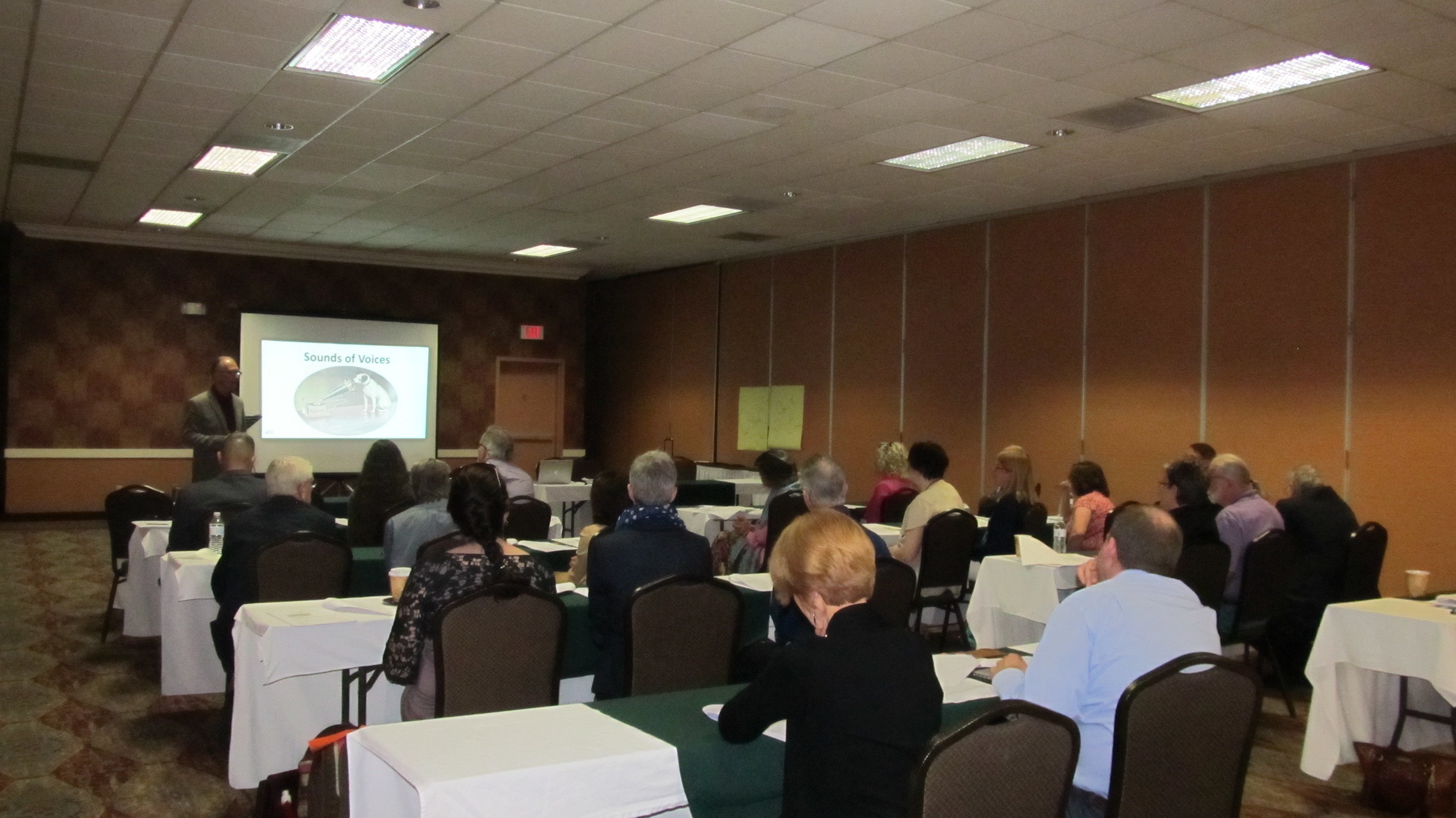
I was recently a speaker at the ILA International Listening Association Convention in Tucson AZ, presenting on “Can Appreciative Listening be a way to (re)discover the motivation to listen to people?”.
After attending a first session as a participant, I quickly realized it was about sharing passion and knowledge far more than information and lectures. At this Convention I felt immediately welcome, warmly invited to contribute, that my voice made a difference and that I was listened to.
ILA members are a very special audience. I’ve rarely been listened to with such attention. Everyone looks at you with the greatest interest and nobody fiddles with a pen or electronic device.
It was an immense honor to have such experienced listeners amongst the audience, including some living legends of Listening, the authors whose books and papers I have read with great interest. They don’t have anything to prove. Despite their immense experience, they still are eager to learn. It was a lesson in real leadership and humility.
At this Convention I received many insights on Listening from so many angles, and I want to share some with you.
One stunning observation that is recurrent these days is that many people, being used to communicating through electronic media, are afraid to meet and speak to a real person. It’s a problem for communication at large, between family members or peers at work, students among themselves… accentuated by the position, hierarchy or age. How can you meet the love of your life under these circumstances?
Among the many applications of the intentional practice of listening, I was impressed by an ILA member who assists policemen in his district to help them to be more effective listeners. This contributes greatly to replace violence by communication and understanding.
We also observed that when you learn to be a more effective Listener, you become almost automatically a more effective speaker. You know how to present your material better for the Listener to have the maximum of comprehension and retention. You become “listenable”. And that’s what speakers want, don’t they?
A Listeners' Convention?
Before leaving for Tucson, when I said I was going to a “Listeners Convention, the joke I heard the most was “A listeners’ convention? But who’s talking? Hahaha!”
Believe me, these passionate listeners, researchers, authors and teachers have a lot to transmit. And they won’t have to speak or write very long to make you realize that you may have missed one of the main components in communication!
Good news, listening can be learned!
If you missed the teachings of Ptahhotep 4000 years ago, or the writings of Plutarch 2000 years ago, and many others along the way, there’s a lot of comprehensible material nowadays to learn and practice Listening to assist you in bettering yourself, your family, your community… and the world at large.
If you’re not satisfied with the way you listen or the way you’re listened to, it may be time to become aware of your listening behaviors.
Before filling a complete listening assessment, start simply by drawing two columns (on paper or electronic…). Label the first one “When do I listen?” the other one “When am I listened to?”. At every moment of your day put a tick in the corresponding column. Too simple? You’ll let me know after just one day how your awareness on Listening has increased. Repeat the process for one week. Count the ticks. Compare one day with another.
Another way to realize the importance of listening as a tool to attain very concrete goals is to ask yourself “When did I encounter these kind of situations (or similar)?”
- You’ve lost important information (or data, money, clients, providers, partners…) / someone lost yours.
- You’ve hurt feelings / you’ve been hurt.
- You’ve missed opportunities / you’ve made others miss opportunities.
Learning to listen is not linear. Neither is the way we teach it.
One way I sometimes approach teaching how to listen to people is the same way I teach listening to music. It all begins with sound. We call this “Appreciative Listening”. If you like the sound of what you hear you’re more inclined to make the extra effort to pay attention in order to understand.
Whatever the approach, as soon as you become aware of the benefits of learning even just one listening skill, your overall listening effectiveness will take a leap forward!
“Ears can go where eyes can’t see”
Jean-François MATHIEU (jfm) April 2016
Music composer, improviser, producer, teacher, Listening Culture Designer
More about listening: www.leaderstoday.co/listen-lead